3D delivery
Optimized glTF/GLB assets, WebGL and Three.js-based viewers for fast browser access without specialist desktop software.
Industrial 3D & digital twins
MARVEX transforms plants, production lines, warehouses, utilities, and technical assets into navigable 3D operational environments—connecting spatial context with the data teams need to act.
Start a conversation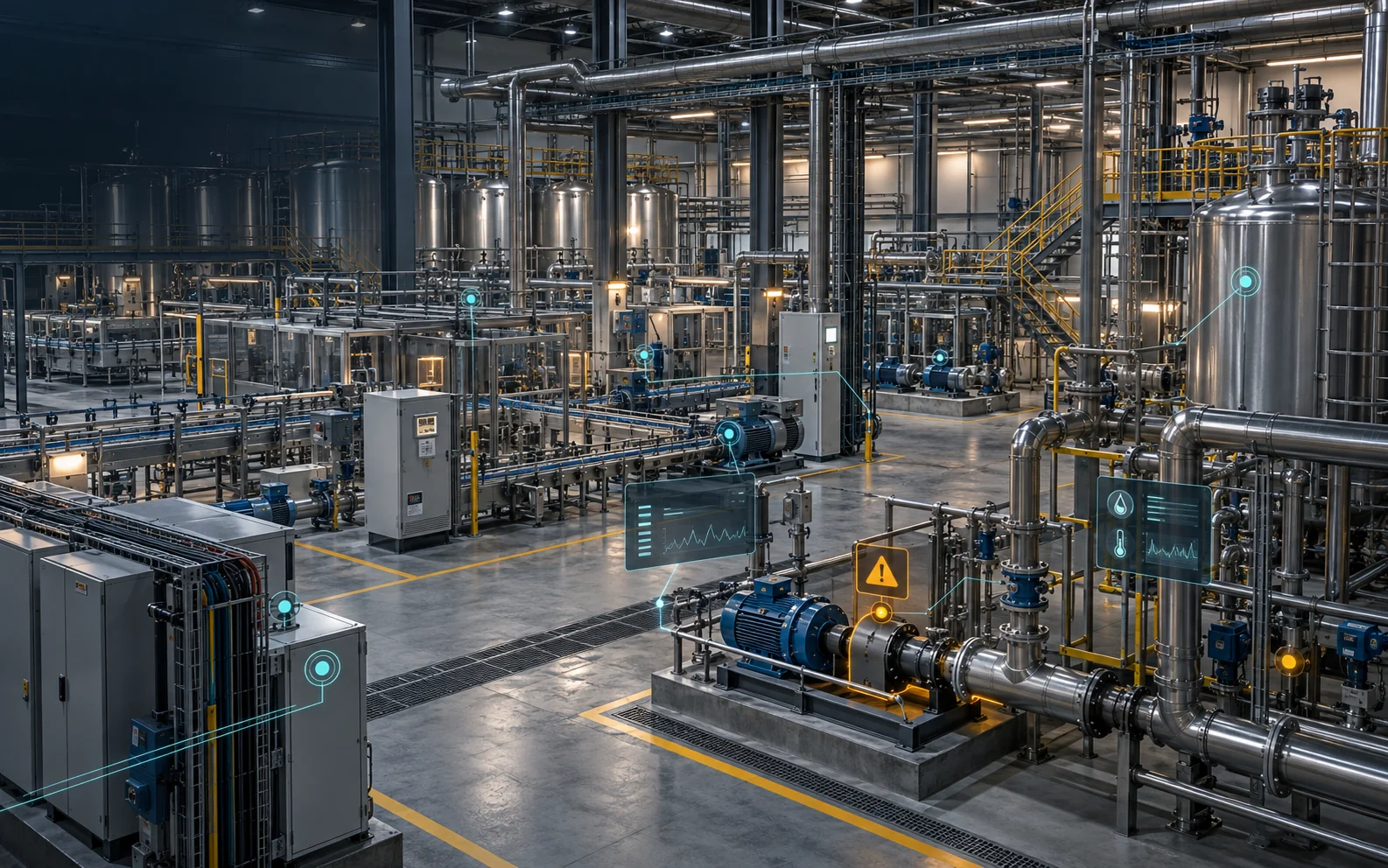
INTERACTIVE DEMO
Drag to orbit the facility, scroll to zoom, or select equipment from the asset list. The fault simulation automatically moves the camera to the correct sensor and motor.
Drag: orbit · Wheel: zoom · Marker: select asset
Technical architecture
We select the final architecture for the facility, model size, integration landscape, security profile, and required operating environment. A typical MARVEX implementation can combine the following technologies:
Optimized glTF/GLB assets, WebGL and Three.js-based viewers for fast browser access without specialist desktop software.
Project-defined CAD, BIM/IFC, point-cloud, drawing, and asset-register inputs are normalized into a controlled web delivery format.
TypeScript and React interfaces with Fastify services for asset search, workflows, integrations, permissions, and operational APIs.
PostgreSQL for structured asset and workflow records; private object storage such as Cloudflare R2 for approved model files, documents, and versioned artifacts.
Authenticated REST APIs, webhooks, scheduled ingestion, or approved connectors for SCADA, BMS, CMMS/EAM, IoT, ERP, and document systems.
Containerized or edge-assisted delivery with separate development, staging, and production environments and project-specific regional boundaries.
Security and privacy by design
Industrial geometry, asset identity, maintenance history, and live operating values can all be sensitive. We therefore design each project around explicit data ownership, controlled access, traceable changes, and the minimum information needed for the use case.
Live operational connectivity is enabled only after the data source, authorization model, environment, retention rule, and failure behavior are validated. If a source is unavailable or its identity cannot be verified, the interface fails closed rather than presenting uncertain data as live.
Role-based access, least-privilege service credentials, strong administrator authentication, and separate client, market, and environment boundaries.
Private storage by default, encrypted transport through TLS, provider-managed encryption at rest, controlled download paths, and versioned model artifacts.
Only approved fields and assets are ingested. Raw source data is not duplicated when a narrower operational view is sufficient.
Retention periods, archive rules, export requirements, and verified deletion workflows are agreed for the project instead of being left indefinite.
Administrative actions, integrations, model versions, and critical workflow changes can be recorded with actor, time, target, and reason.
Credentials remain outside the 3D files and client interface; server-side gateways validate identity, scope, source, and expected data shape.
We prepare fit-for-purpose 3D facility models and connect approved operational data to the right building, floor, line, machine, or component. Instead of searching across drawings, spreadsheets, sensor screens, and maintenance records, teams can begin with the physical context: where the issue is, what it affects, who owns it, and what should happen next.
A structured 3D representation of buildings, production areas, machinery, pipelines, electrical systems, utilities, access routes, and other project-defined assets.
Authorized sensor readings, status signals, alarms, maintenance records, documents, and business metrics can be associated with the relevant 3D asset through controlled integrations.
Alerts can direct technical teams to the affected area or component, reducing the time spent identifying the physical source of an incident.
Each asset can be associated with compatible parts, manufacturer references, stock location, available quantity, manuals, and purchasing information so the intervention team knows what to bring before reaching the equipment.
Asset history, work instructions, responsible teams, priority, and progress can be presented in context to support faster and more consistent field action.
Operators, maintenance teams, engineers, and managers can receive views designed around their responsibilities without exposing unnecessary information.
The shared 3D context helps teams explain changes, review access and dependencies, prepare interventions, and communicate complex facilities more clearly.
Define the facility, operational questions, users, source material, data availability, and required level of detail.
Build and organize the approved physical scope into a performant, navigable 3D asset structure.
Map approved data sources, documents, alarms, and workflows to the correct assets with traceable identifiers.
Deliver the experience through a secure web or project-specific interface, then refine it around real operational use.
DIGITAL OPERATIONS
Every implementation is scoped to the client’s facility, available source material, systems, security requirements, and operating priorities. A project may begin as a focused 3D asset viewer and grow into an integrated digital-twin workspace. Live values are presented only when an authorized, validated data source is connected; the interface clearly distinguishes live, historical, calculated, and manually maintained information.
Share the facility type, source drawings or models, and the operational problem you want to solve. MARVEX will define a practical first phase and an expandable technical path.